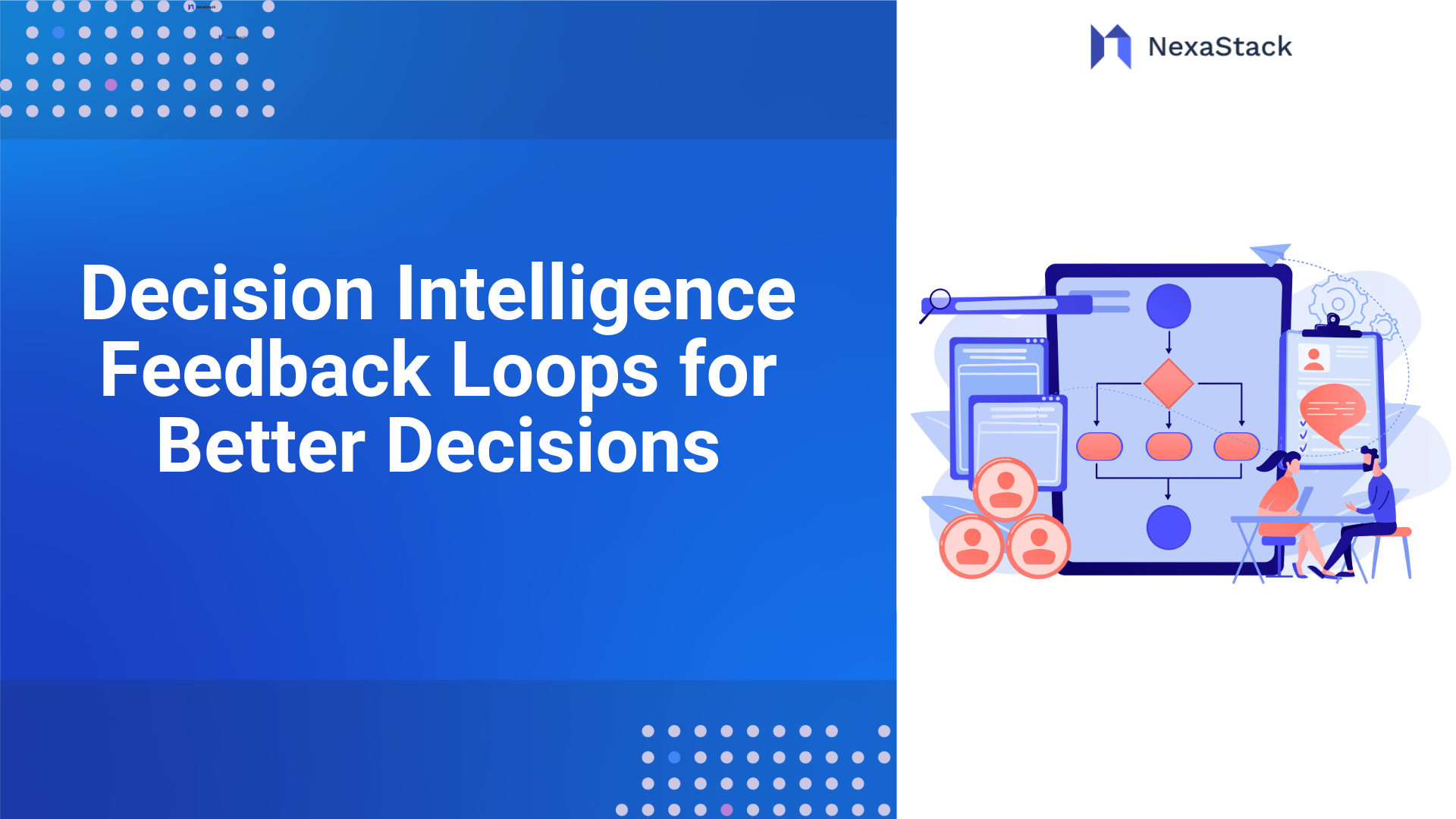
How do you design feedback loops for better decision intelligence?
Designing feedback loops for better decision intelligence means creating a system where enterprise decisions are continuously informed, evaluated, corrected, and improved through connected data, business context, workflows, and outcomes. Instead of treating decisions as one-time events, organizations build feedback loops that connect data analytics, AI agents, AI insights, AI dashboards, agentic analytics, augmented analytics, context engineering, context graph architecture, decision AI, data observability, data quality, data management, DataOps, data governance, data security, data protection, and data warehouse strategy into an operating model that learns from results and strengthens future action.
Key Takeaways
- Decision intelligence improves when feedback loops connect signals, actions, outcomes, and learning across the enterprise.
- Strong feedback loops help organizations improve decision speed, decision quality, governance alignment, and operational resilience.
- AI agents, AI insights, and AI dashboards become more valuable when they operate inside systems that learn from outcomes rather than only generate outputs.
- Data quality, data observability, metadata, and lineage are essential because weak feedback signals weaken future decisions.
- Context engineering, DataOps, and data management help enterprises make feedback loops scalable, explainable, and trustworthy.
Why feedback loops matter in decision intelligence
Decision intelligence is not only about making one good decision. It is about improving how decisions are made over time. In modern enterprises, conditions change constantly. Customer behavior shifts, workflows evolve, dependencies change, policies are updated, risks emerge, and strategic priorities move. A decision that worked well in one situation may need to be adjusted in another.
This is why feedback loops are essential. They allow the enterprise to learn from action, not just from analysis. They help answer important questions such as whether a recommendation actually improved the outcome, whether the decision was made quickly enough, whether the right workflow was triggered, whether the policy logic held up, and what should change next time.
Without feedback loops, decision intelligence becomes static. It may generate insights and recommendations, but it will not continuously improve. With strong feedback loops, the enterprise creates a system that learns from outcomes and becomes more adaptive.
Why reporting alone does not create learning
Many organizations already measure performance through reports, dashboards, and KPIs. That is useful, but reporting alone does not always create learning. A dashboard can show the result of a decision without showing how the decision was made, what context shaped it, or whether the workflow and recommendation logic should change in response.
For example, a team may see that service recovery took too long, that a customer escalated, or that a financial exception caused delay. But unless the organization connects that outcome back to the decision process itself, the system does not truly learn. It only records the result.
This is one reason feedback loops are such an important part of decision intelligence. They connect performance measurement back to the actual decision path, making it possible to improve not just outcomes, but the way the enterprise reaches them.
What a feedback loop in decision intelligence actually does
A feedback loop in decision intelligence connects four things: signals, decisions, actions, and outcomes. It helps the enterprise understand how a signal was interpreted, what action followed, what result occurred, and what should be adjusted the next time a similar condition appears.
A strong feedback loop does not stop with “did the action happen.” It asks deeper questions:
- Was the issue prioritized correctly?
- Did the right owner receive it?
- Did the workflow fit the actual situation?
- Was the action policy-aligned?
- Did the outcome create business value?
- Was there an avoidable delay or unnecessary escalation?
- What should the decision system learn from this result?
This is what turns decision intelligence into a continuously improving operating model instead of a one-time analytical capability.
Why context is essential in feedback loops
Feedback loops are only useful if they preserve business context. A decision outcome cannot be understood well if the enterprise loses track of what made that decision important in the first place. Was the issue tied to a strategic customer? A regulated workflow? A high-risk dependency? A low-priority internal event? The same outcome can mean different things depending on that context.
This is why context-aware feedback loops are more powerful than simple outcome tracking. They help the enterprise understand not just whether an action succeeded, but whether it was appropriate in the business situation. Context helps determine whether a result reflects a strong decision, a lucky decision, or a weak decision that happened to avoid visible damage.
That is why context engineering plays such a central role in designing better feedback loops.
Why context engineering improves learning systems
Context engineering helps feedback loops become more meaningful because it defines how the relevant business context around a decision is structured and retained. That includes entities, workflows, policies, dependencies, ownership, source authority, and metadata.
Without context engineering, feedback often becomes shallow. Teams can see that something succeeded or failed, but they cannot easily determine why. With context engineering, feedback loops can connect outcomes back to the decision path and the business relationships that shaped it. This makes learning more actionable.
For example, if a decision failed, the enterprise can examine whether the problem came from missing context, unclear ownership, outdated workflow logic, weak policy interpretation, or poor prioritization. That is much more useful than simply recording that the outcome was negative.
Why context graph architecture makes feedback loops stronger
Context graph architecture is especially useful for decision intelligence feedback loops because it preserves relationships across signals, workflows, actions, and outcomes. A context graph can connect customers, services, approvals, incidents, policies, owners, metrics, decisions, and resulting business impact into one shared model of enterprise meaning.
This makes it easier to trace what happened, what mattered, and what should change next time. The enterprise can examine how a signal moved through the decision system, which entities and workflows were involved, which controls applied, and how the final outcome affected the business.
That level of traceability is important because it helps transform feedback from isolated measurement into structured learning. It also improves explainability, which is critical when feedback influences future recommendations, automation thresholds, or governance rules.
Why feedback loops improve decision speed
One of the clearest benefits of well-designed feedback loops is better decision speed. When the enterprise learns where delays happen, it can reduce friction in future workflows.
For example, a feedback loop may reveal that a decision was delayed because ownership was unclear, because context was gathered too late, because an approval threshold was too rigid, or because teams needed to switch across multiple systems to understand the situation. Once those patterns are visible, the decision layer can be improved.
Over time, this allows enterprises to move faster without simply forcing speed. They improve speed by removing the specific factors that slowed action before. This is much more sustainable than adding more alerts or more dashboards and hoping teams will respond faster.
Why feedback loops improve decision quality
Better speed is useful, but decision intelligence also depends on decision quality. Feedback loops strengthen quality by helping the enterprise compare expected outcomes with real outcomes and examine where interpretation or action fell short.
A recommendation may have seemed reasonable at the time, but the outcome may reveal that the issue was misprioritized, that the wrong workflow was triggered, or that the business context was incomplete. Feedback loops help organizations identify these gaps and improve future recommendations.
This is especially important when AI agents or decision AI are part of the system. Enterprises need a way to evaluate whether the model is improving actual decisions rather than simply producing plausible outputs.
Why AI agents need feedback loops to improve over time
AI agents become significantly more useful when they operate inside systems with strong feedback loops. Without feedback, an AI agent may continue making the same weak assumptions or repeating the same routing logic even after the business sees poor results. With feedback, the enterprise can refine how the agent interprets context, when it escalates, how it prioritizes, and what outcomes it should optimize.
For example, an AI agent helping with incident triage may initially over-escalate cases. Feedback loops can reveal that pattern and help the enterprise adjust thresholds, contextual factors, or workflow logic. A customer-facing agent may recommend actions that are technically valid but commercially weak. Feedback loops can help align that agent more closely with business goals.
This is one reason AI agents are so closely linked to decision intelligence. They are most effective in systems that can learn from outcomes rather than simply execute instructions.
For enterprise deployment and orchestration of AI systems and AI agents, NexaStack as AI MSP - Unified Inference Platform can support scalable intelligent execution across enterprise decision environments.
Why AI insights and AI dashboards should reflect feedback signals
AI insights and AI dashboards are often used to monitor decisions, but they should also become part of the feedback loop itself. Instead of only showing historical performance, they should help teams understand where the decision system is learning and where it is still weak.
That means dashboards should not only show outcomes. They should also show trend patterns in decision speed, override frequency, workflow friction, escalation quality, policy exceptions, and recommendation effectiveness. AI insights should help explain where the feedback signals point to systemic improvement opportunities.
This is where augmented analytics and agentic analytics become more valuable. They support not only interpretation of business performance, but interpretation of how the decision system itself is performing and evolving.
For organizations using AI-driven analysis to support connected business action, Agent Analyst can support context-aware AI insights, AI dashboards, and enterprise analysis.
Why governance should be part of the feedback loop
In decision intelligence, learning should not focus only on speed or outcome efficiency. It should also measure whether decisions remained aligned with governance, policy, and accountability requirements.
A fast action that violates policy is not a success. A highly automated recommendation that bypasses required oversight is not a sign of maturity. Feedback loops should therefore include governance outcomes such as approval compliance, audit traceability, policy alignment, escalation appropriateness, and override behavior.
This is especially important in regulated or high-stakes environments, where the decision system must learn not just how to act faster, but how to act responsibly under control. Governance-aware feedback helps the enterprise improve without weakening trust.
For governed and secure AI operations, Agent GRC, Agent RAI, Agent Trust Score, and Meta Secure AI can support responsible, policy-aware, and secure AI execution.
Why data quality determines the quality of feedback
Feedback loops are only as useful as the quality of the information they collect. If outcomes are measured against stale context, broken relationships, incomplete workflow records, or weak source authority, the enterprise may draw the wrong lessons.
That is why data quality is fundamental. The enterprise needs confidence in entity resolution, relationship integrity, freshness, metadata completeness, workflow relevance, and source authority across both the original decision and the resulting outcome signals. If those foundations are weak, the system may improve in the wrong direction.
For enterprises building trusted data foundations for decision intelligence, Elixir Data can support data quality, metadata, lineage, data management, and observability capabilities.
Why data observability is essential for effective feedback loops
Data observability is just as important because feedback loops depend on current, trustworthy signals over time. If the decision environment drifts, if workflows change without being tracked, if schema updates break relationships, or if key outcome signals are delayed, the learning system becomes unreliable.
Data observability helps monitor freshness, lineage gaps, missing updates, drift, context health, and downstream effects on decisions and outcomes. This is essential because the enterprise needs to know not only what was learned, but whether the inputs to that learning remain trustworthy.
Without observability, feedback loops can become misleading. They may appear to show improvement while actually masking degradation in the underlying context.
Why DataOps and data management make feedback loops sustainable
Designing one useful feedback loop is not enough. Enterprises need sustainable learning across many workflows, systems, and decision types. That is where DataOps and data management become critical.
DataOps helps manage ingestion, testing, deployment, validation, monitoring, and change control across the data and context pipelines that feed the decision layer and its feedback loops. Data management provides stewardship, discoverability, lifecycle control, metadata standards, lineage, and semantic consistency. Together, they help enterprises scale feedback loops without creating confusion or fragmentation.
This matters because decision intelligence is not a one-time architecture project. It is an evolving operating model that becomes more valuable as feedback improves it over time.
A practical design pattern for decision intelligence feedback loops
A practical way to design feedback loops is to connect five elements.
The first is the signal that triggered the decision. This may be an alert, metric, exception, or recommendation.
The second is the context used at the time of decision. This includes workflow state, ownership, policies, dependencies, and business importance.
The third is the action taken. This may be a routed task, approval, escalation, automation step, or human review.
The fourth is the outcome observed. This includes speed, business impact, customer response, control result, or operational effect.
The fifth is the adjustment mechanism. This is how the enterprise changes thresholds, workflow logic, contextual features, governance rules, or AI agent behavior based on what was learned.
When these five elements are connected, feedback becomes a real design capability rather than a retrospective reporting exercise.
How enterprises should start building better feedback loops
The most effective starting point is to choose one high-value decision flow where outcomes are visible and improvement matters. This could be incident response, approval routing, customer escalation, policy exception handling, financial review, operational prioritization, or service recovery.
From there, the enterprise should define what triggers the decision, what context is needed, what actions are possible, what outcomes matter, and what signals should be used for learning. It should also decide where AI agents, AI insights, or decision AI will participate and what governance rules should shape feedback-driven improvement.
Once the first loop is working and generating useful learning, the model can be extended into adjacent workflows. This helps the enterprise create a broader learning architecture for decision intelligence.
How NexaStack supports feedback loops for better decision intelligence
NexaStack supports better feedback loops for decision intelligence by strengthening the data, AI, governance, observability, and execution layers needed for connected enterprise learning and action.
For trusted data foundations, metadata, lineage, data quality, and data observability, Elixir Data can support resilient data management and enterprise context readiness. For enterprise deployment and orchestration of AI systems and AI agents, NexaStack as AI MSP - Unified Inference Platform can support scalable intelligent execution.
For AI insights, AI dashboards, data analytics, augmented analytics, agentic analytics, and decision intelligence, Agent Analyst can support context-aware analytical reasoning. For governance, secure AI, and responsible execution, Agent GRC, Agent RAI, Agent Trust Score, and Meta Secure AI can support governed and policy-aware operations.
Where context-aware retrieval and connected enterprise knowledge are required, Agent Search can support discovery across distributed systems. Where runtime visibility and operational resilience matter, Agent SRE and Agent ITOps can support resilient operations. For ongoing evaluation of AI behavior and decision performance, Agent Evaluation can support structured measurement.
Conclusion
Designing feedback loops for better decision intelligence helps enterprises move beyond static analytics and one-time recommendations into a more adaptive, learning-centered model of business action. It connects data analytics, AI agents, AI insights, AI dashboards, agentic analytics, augmented analytics, context engineering, context graph architecture, decision AI, data observability, data quality, data management, DataOps, data governance, data security, data protection, and data warehouse strategy into a system that improves through use.
Enterprises that design these loops well will be better positioned to make decisions that become faster, more accurate, more governable, and more valuable over time.
FAQ
What is a feedback loop in decision intelligence?
A feedback loop in decision intelligence is a process that connects signals, decisions, actions, outcomes, and learning so future decisions improve over time.
Why are feedback loops important for decision intelligence?
They are important because decision intelligence should not only support one good decision, but also help the enterprise learn from outcomes and continuously improve its decision process.
How do AI agents benefit from feedback loops?
AI agents benefit because feedback loops help refine how they prioritize, route, escalate, and recommend actions based on real business outcomes.
Why is context important in feedback design?
Context is important because outcomes only make sense when the enterprise understands the workflows, ownership, policies, and business conditions that shaped the original decision.
Why do data quality and observability matter so much in feedback loops?
They matter because weak, stale, or incomplete context can lead to poor learning, causing the decision system to improve in the wrong direction.
How should an enterprise start building decision intelligence feedback loops?
An enterprise should start with one high-value decision flow, connect the signal-to-outcome path, measure the results, and use that learning to refine workflows, context, governance, and AI behavior.